 |
|---|
POLITICS-ACTIVISM
"Democracy is the government of the people, by the people, for the people."
Abraham Lincoln, 1809-1865, American President
It was not just in the business world where Greek immigrants and their descendants were prominent in the ’70s. Greek-Americans also experienced great success in science and politics. Among them was Michael Dukakis, who was elected governor in Massachusetts in 1974. His nomination as the Democratic Party candidate in the 1988 US presidential elections -- the first son of an immigrant who managed to go so high in politics - was a focal point that invigorated feelings of security and confidence in the Greeks in America.
Dukakis’ run was indeed a landmark in the history of America, since the candidacy of former Governor of Massachusetts showed that in the race for the presidency, everyone had the right to run regardless of his nationality.
Undoubtedly, it was an era that changed attitudes. Many Americans of Greek descent, as well as of non-Greek descent, who had never been involved in politics before, were rushing to help with much enthusiasm. Until then, the Anglo-Saxons were the first and the dominant ones in politics. The rest of the people, though it was not openly admitted, were considered "second class."
The mobilization of the Greek faction was unprecedented. All of us were acting as if we had wings and were offering everything in our power. Interestingly enough, many of our countrymen, despite being American citizens, had never voted until then. They had never registered to vote, fearing that they would be called upon to perform judicial functions, and consequently revealing their far from excellent knowledge of the language.




In addition, it consolidated the Greek lobby. Those of us who were actively engaged in this case did not realize it at that time, but the mobilization of the Greek community altered the image that other Americans held of Greek-Americans.
Politics were, for me, a secret desire. At that time, I found the right opportunity to get involved in the American public sphere. Every week, for two years, I commuted between New York and Boston to participate in the meetings we held to plan events, organize lectures and fund-raise for Dukakis’s political campaign.
In Brooklyn, we had a very strong Greek Committee supporting Michael Dukakis’s candidacy who met weekly. That Committee continued its action even after the presidential elections. Along with Basil Kapetanakis and Mark Marinakis, we worked with vigor, passion, pride and faith in our abilities. The Queens Committee, headed by Tasos Manesis, was also active.


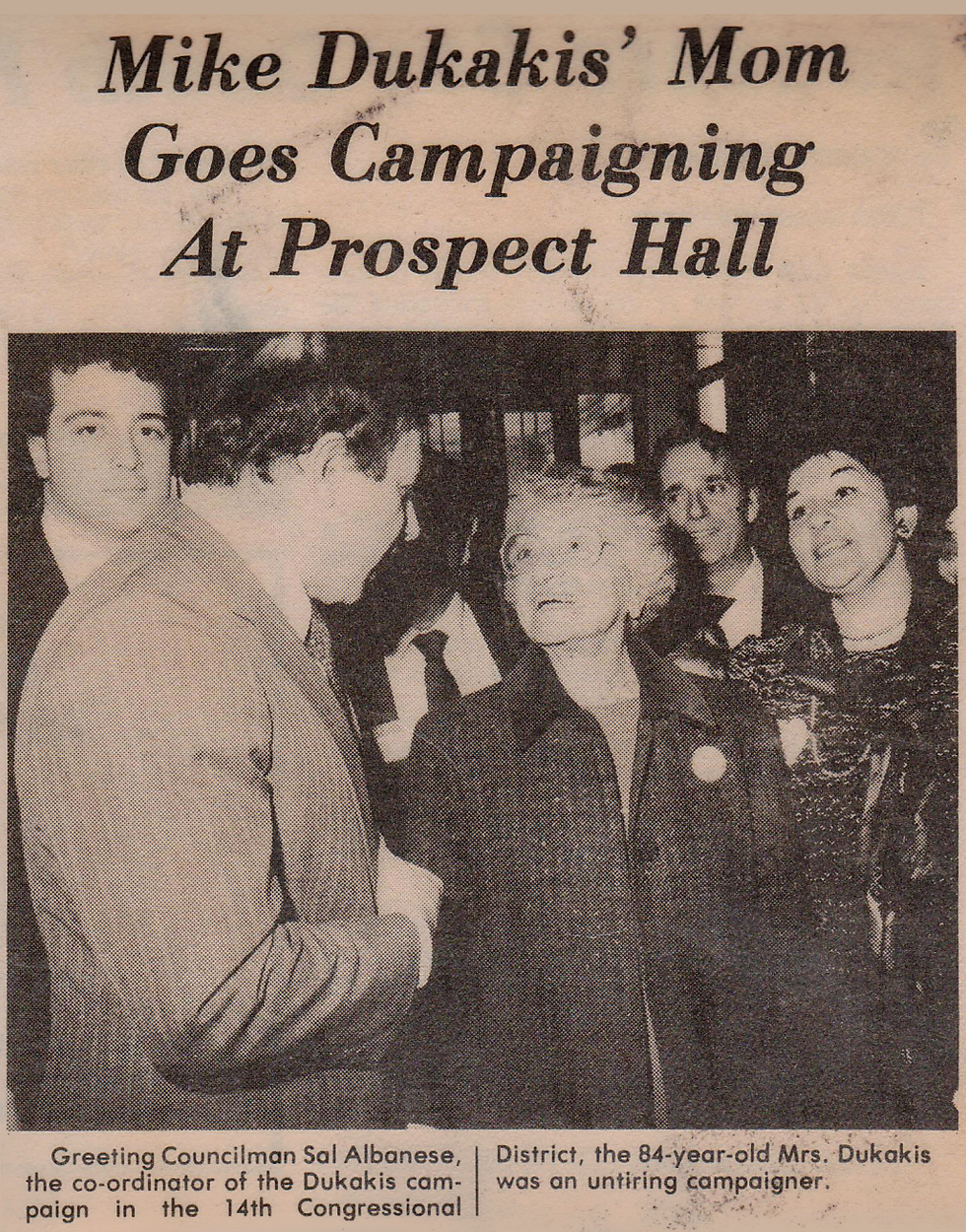
During the campaign, we worked wholeheartedly to promote Michael Dukakis. Among other things, I was responsible for the cultural events in Brooklyn. Together with my colleagues we organized very successful events and raised over half a million dollars, not only from Greeks but also from Syrians, Lebanese, Spanish and others. We also organized a reception for Dukakis’ mother, Mrs. Euterpe, at Prospect Hall in Brooklyn in March 1988. It was a very moving event that gathered large crowds.
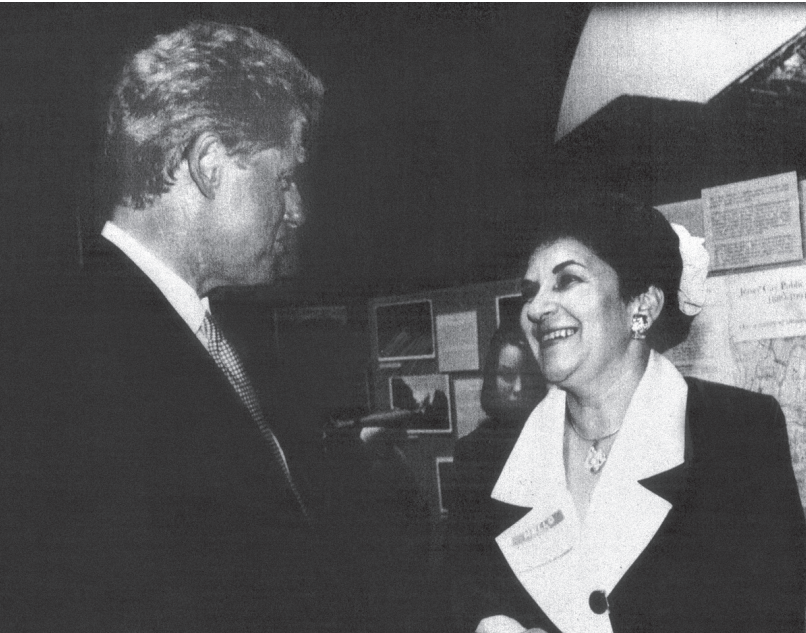
Those years were my most memorable, since I experienced all the events so intensely and from the “inside.” The trip to Atlanta, Georgia, where Dukakis was nominated as the Democratic presidential candidate, was an exciting experience. Bill Clinton attended, and we tried to teach him how to dance Syrtaki. We wrote our own story; as the faces of Hellenism in America, we boosted our morale. They were glorious days, filled with excitement, joy and brotherhood, that I fondly remember. We celebrated out in the streets. And my kids, Spyros and Rodamanthos, then aged 14 and 10 respectively, were part of the election campaign, handing out fliers and helping to serve food.
During the two years of the campaign, my husband gave us use of one of his two medical offices to hold our meetings. This was our "headquarters.”
Greeks from Queens came to us to coordinate our actions. Every Thursday we held great meetings, and the receptions we organized attracted over 1,000 people each time.
I had developed a great friendship with Dukakis. What I remember of him is that he told me "You're a fantastic Greek woman and I want you to be with me until the end of our campaign for the presidency." He wrote this in a letter, in which among other things, he also told me how much he liked the walnut cake that I prepared each time he was going to join us. Often he told me to say hi to my mother-in-law just for fun. His Greek was not exceptional, but his soul was genuinely Greek. I remember, at a major event in Boston in 1987, he asked me to speak on the contribution of Greek democracy to the Western World. I spoke in English, as the great majority of attendees were non-Greeks.
Dukakis presented me excitedly, saying that the next time the teacher will speak in Greek and that he will translate. He laughed, but he had indeed a great esteem for me, and recognized my contribution. I still keep the thank-you letters that Dukakis sent me. For me, ultimately, the moral reward is greater.
One of the benefits of Dukakis’s candidacy was that he brought Hellenism closer. He was destined to be a start for young Greeks to promote their careers in American politics. I mention a few of them as examples: Paul Sarbanes, with roots in Laconia, who is the longest serving senator in the history of the State of Maryland, having served from 1977 to 2007;
Michael Bilirakis, a member of the House of Representatives from 1983 until 2007, representing the 9th district of Florida. Their sons, John Sarbanes and Gus Bilirakis, today deservedly continue the political careers of their parents. Another worthy representative of the Greeks is Dina Titus from Arizona, who traces her roots to Trikala. Of course, I cannot fail to mention Olympia Snowe, daughter of Greek immigrants from Sparta, with roots in Mytilene, who in 2006 was included in Time magazine’s list of the "Ten Most Powerful Senators in America."
All of them have contributed and continue to contribute to the promotion of issues of Greek interest in Washington, inspired by the Hellenism-driven values and ideas that ancient Greece offered to all the world and on which the foundation of the political and social system of the United States is grounded.
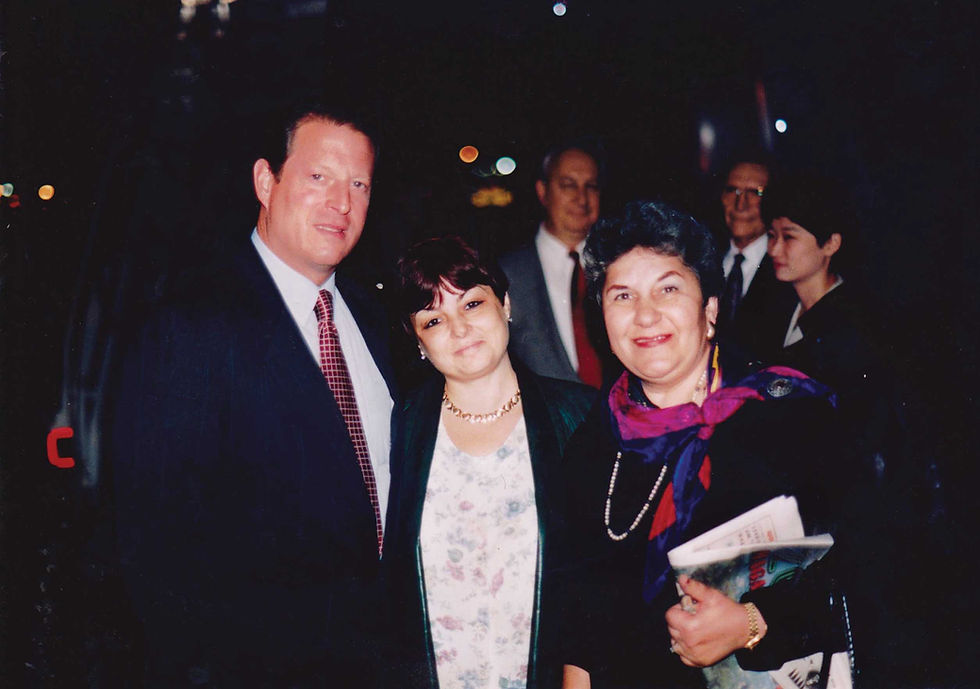
My political action continued with other compatriots who were involved in politics. I supported with zeal and worked tirelessly for the Clinton family, and developed close ties with Bill and Hillary, as well as with Al Gore. In 2000, Bill Clinton personally invited me to the Kennedy Center in Washington to celebrate the arrival of the new millennium, and I brought a jeep full of Greek appetizers and desserts.
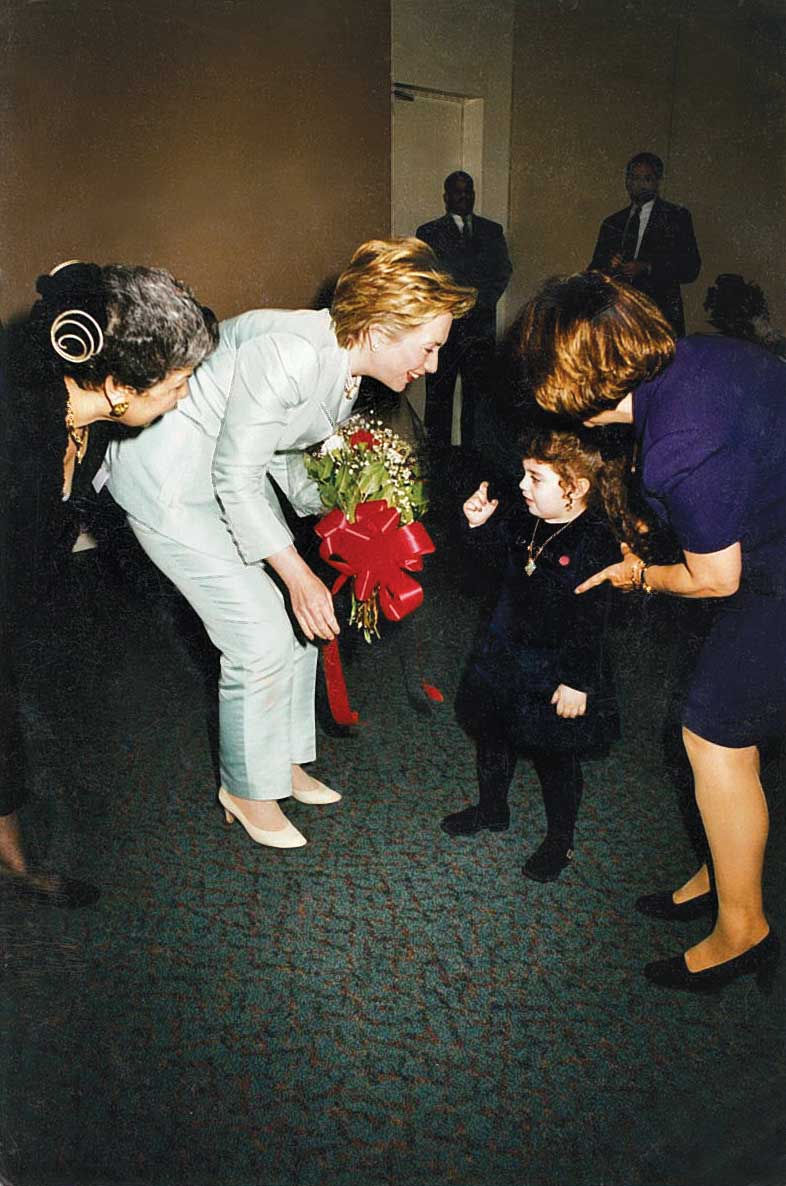
I also admired especially Hillary Rodham Clinton for her dynamism, and I supported her with all my heart in the race to take over the nomination against Obama. I actively assisted her in many of her campaign events in New York and Washington.
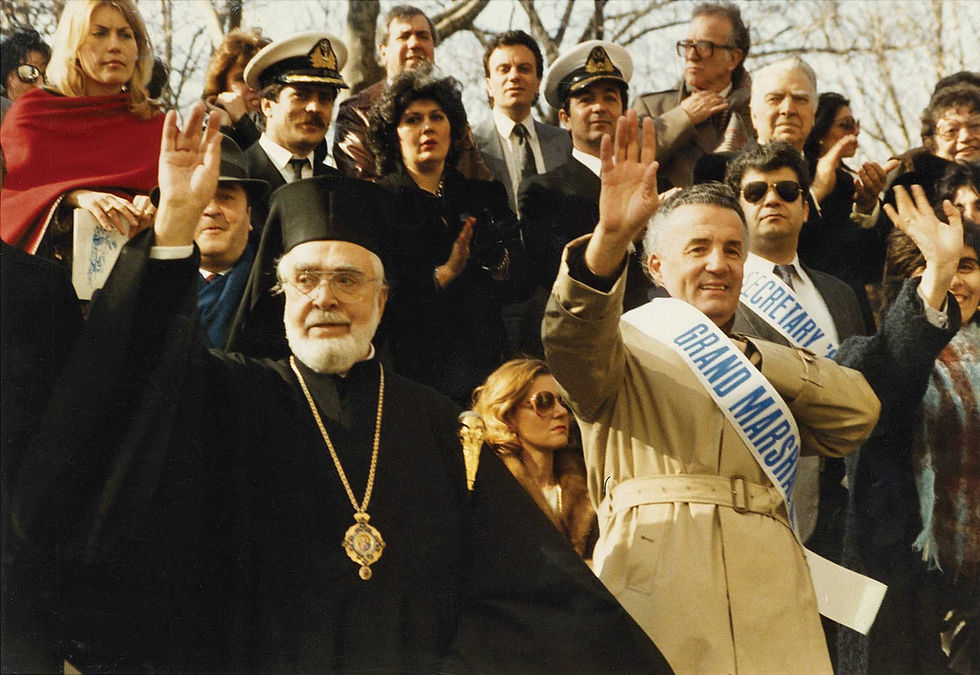
In her turn, she responded enthusiastically to our invitation to attend an event we co-organized with the Coordinating Committee for Social and Cultural Activities of the Hellenic American National Council and the Charitable Institute of Crete, in the frame of the Hermes Expo at the Jarvis Center in April 2000. The First Lady and then-candidate for Senator of New York praised His Eminence Archbishop Iakovos, and presented him with an award among the organizers.
Mrs. Clinton emphasized that the award attributed to His Eminence Archbishop Iakovos for his leading role in and his work with these organizations was a long-due tribute to him, not only by the Greek-Orthodox Church and the Greek-American community, but also by all Americans. She also emphasized that “his struggles against all forms of prejudice and for the sake of peace and human dignity, everywhere, in South Africa, the Middle East, Bosnia, Haiti, Greece and America, yielded fruitful outcomes and continue to constitute a source of inspiration and a beacon that shows us the way to move forward together.” She also talked about what Mr. Iakovos offered in order "to strengthen the ties of friendship between Greece and the U.S.A.” and she stressed “his efforts for the prevalence of a universal culture that embraces all believers of all religions.”
The ceremony was attended by the then new Archbishop of America, Mr. Demetrius, the General Consuls of Greece and Cyprus, Platis and Eliades, the organizers of the event, Theodore G. Spyropoulos, President of the National Council, and Paul Kotrotsios, President of the Hermes Expo. The heads of the organizing committee evening were Zoe Koutsoupakis and myself.
The award of "Woman of 2000" was awarded to Agape Vardinogiannis for her “charitable services in the international arena and the promotion of the Olympic Spirit.”
I have also been associated with another fiery philhellene, federal MP of New York, Carolyn Maloney, "Bouboulina", as we Hellenes Abroad call her. In 1999, I escorted her, along with my students, on her trip to Greece, which she mentions even today. We went to ancient Olympia, Delphi and elsewhere. She thanked me with a personal letter for the great hospitality we offered her, as well as for the presentation of Greece and its monuments that we took her to visit.
I also organized and I continue to organize many events in support of my compatriot Leonidas Raptakis. I am close to him because we both have our roots in Andros.
He is a serious and honest politician with innovative ideas, who has honored the name of the Greek-Americans in the state of Rhode Island. He has participated in all the struggles of the Greek Community for our national issues, and this is why he enjoys the support of the Democratic Party and of the Greek-American community.
Overall, I have organized more than sixty events and fundraisers from the Dukakis era up until a few years ago when I decided to gradually abandon my intense political activism. This, in part, was due to my poor health, but also because I saw and I kept seeing things with which I did not agree.
The intense and sterile confrontation of the two parties in Washington made me move away from an active involvement in politics. Nevertheless, I continue to support politicians of Greek origin and my action in community affairs of Brooklyn continues.
